Have our high school history books really told us the extent of oppression in the United States? Our country has attracted millions of people from around the world looking for a better life for themselves, only to feel socially isolated from the rest of the population. Even though major historical events such as the civil war did end a formal oppressive system, marginalized groups are still oppressed today in forms of microaggressions. In fact, the Land of the “Free” is not exactly the most free…
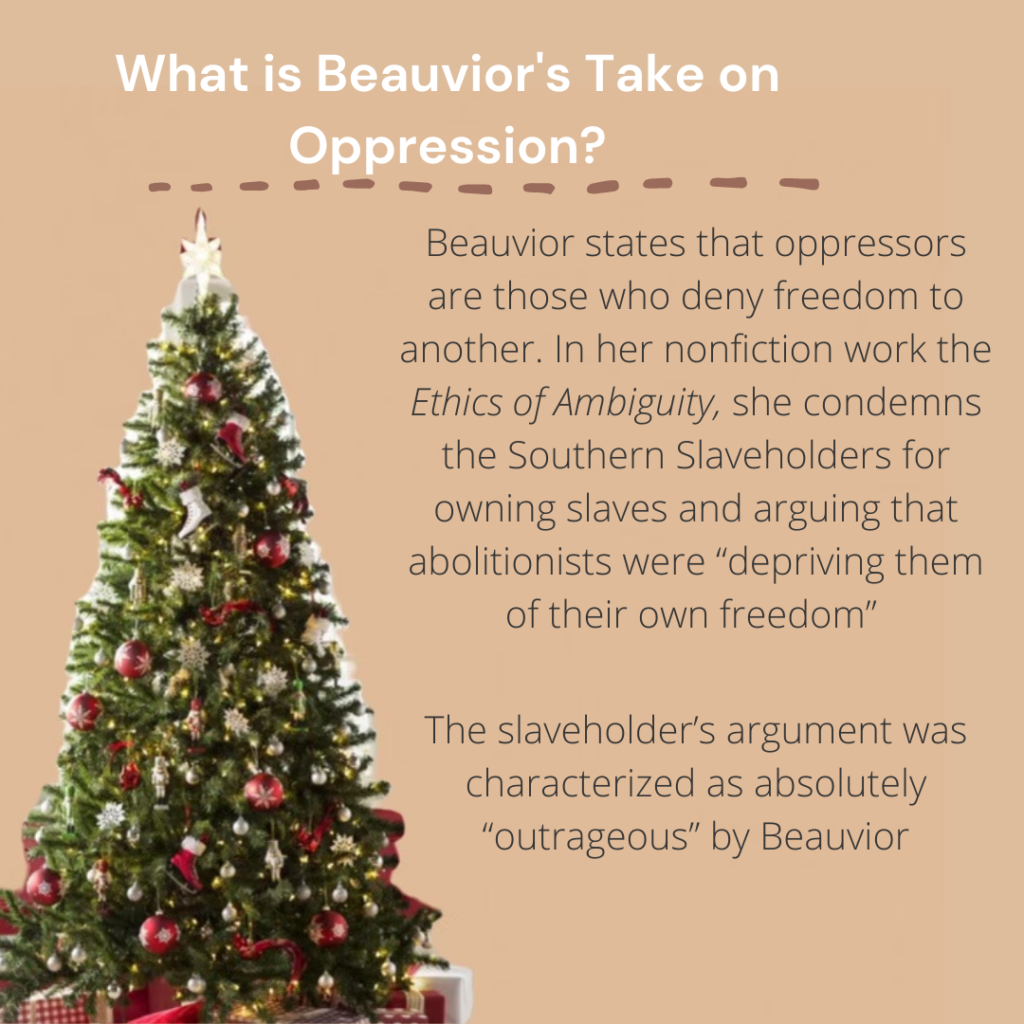
20th century philosopher Simone De Beauvior addresses the history of oppression in the United States in her discussion of freedom. Beauvoir specifically criticizes the Southern Slaveholders during the civil war. When these slaveholders were challenged by the abolitionists, they defended themselves by arguing that this was the abolitionists’ way of disrupting their economy. Beauvoir relates the slaveholders’ objection as “under the pretext of freedom, there you go oppressing me in turn; you deprive me of my freedom (90).”
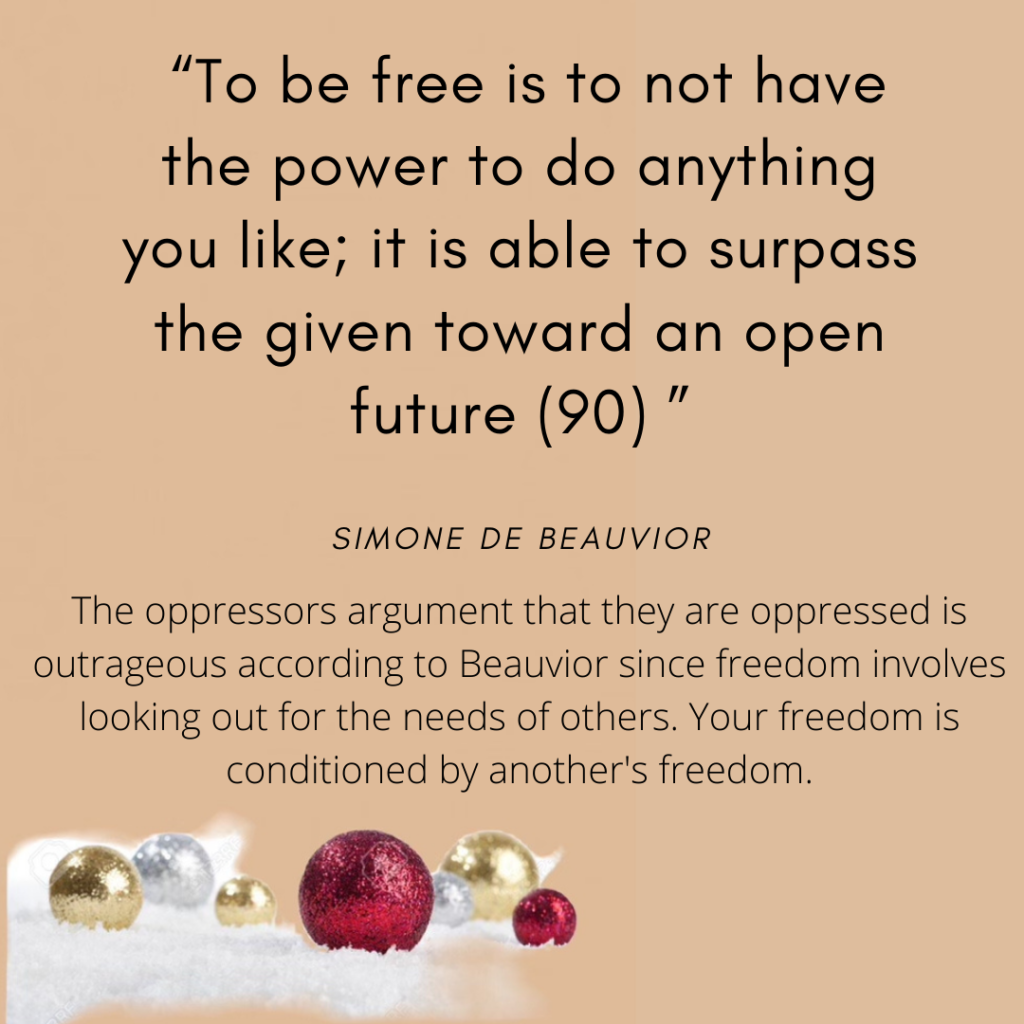
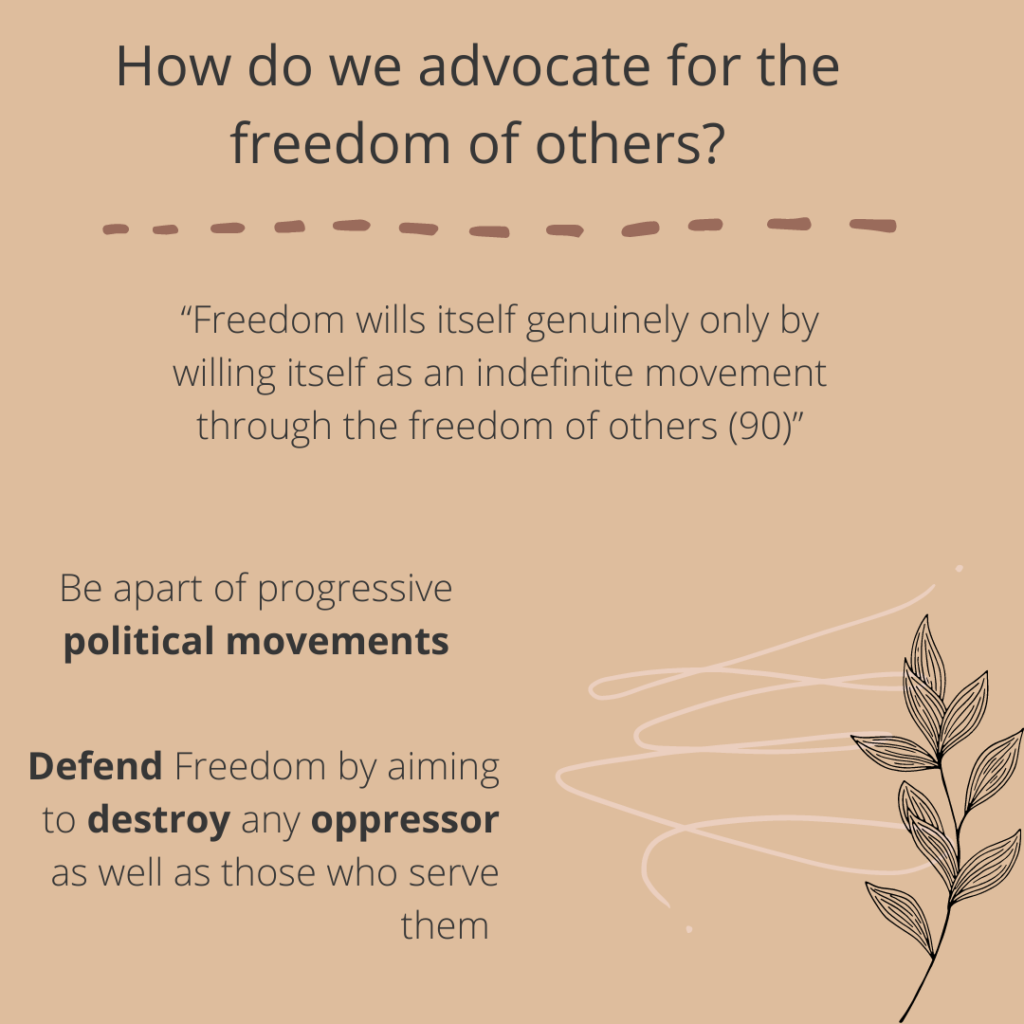
Their idea of freedom is not the true definition of freedom since “to be free is to not have the power to do anything you like; it is able to surpass the given toward an open future (91).” Slaveholders denying freedom to others while demanding that they are being denied their freedom is described as completely “outrageous” by Beauvior. The civil rights movement is an example of how freedom “wills itself genuinely only by willing itself as an indefinite movement through the freedom of others (91).” Political movements that have an overarching goal of dismantling the oppressor are all examples of defending freedom among those that are being oppressed.
Beauvior emphasizes the importance of using political movements to defend and thus create genuine freedom among those individuals. Beauvior was extremely active herself in political movements during her time. Being politically active was Beauvior’s way of fighting and dismissing the oppressors.
How does Beauvior Differentiate who is an oppressor and who’s aware of the sociopolitical issues that exist in the world?
As previously mentioned above, those who deny freedom to others are oppressors. Beauvior specifically mentions that those who serve the oppressor however are not oppressors themselves. A young confederate soldier or a “sixteen-year old Nazi died crying “Heil Hitler!” are not “guilty, and it was not whom we hated but his masters (49)” Although we are obligated to “destroy not only the oppressor but also those who serve him” those who serve the oppressor can be “re-educate the mislead youth (49).” Beauvior argues that those who serve the oppressor technically are not the oppressors and thus we can “change” them, however, anyone who denies freedom to others must be destroyed. We can’t blame those who serve the oppressor the same as the oppressors themselves.
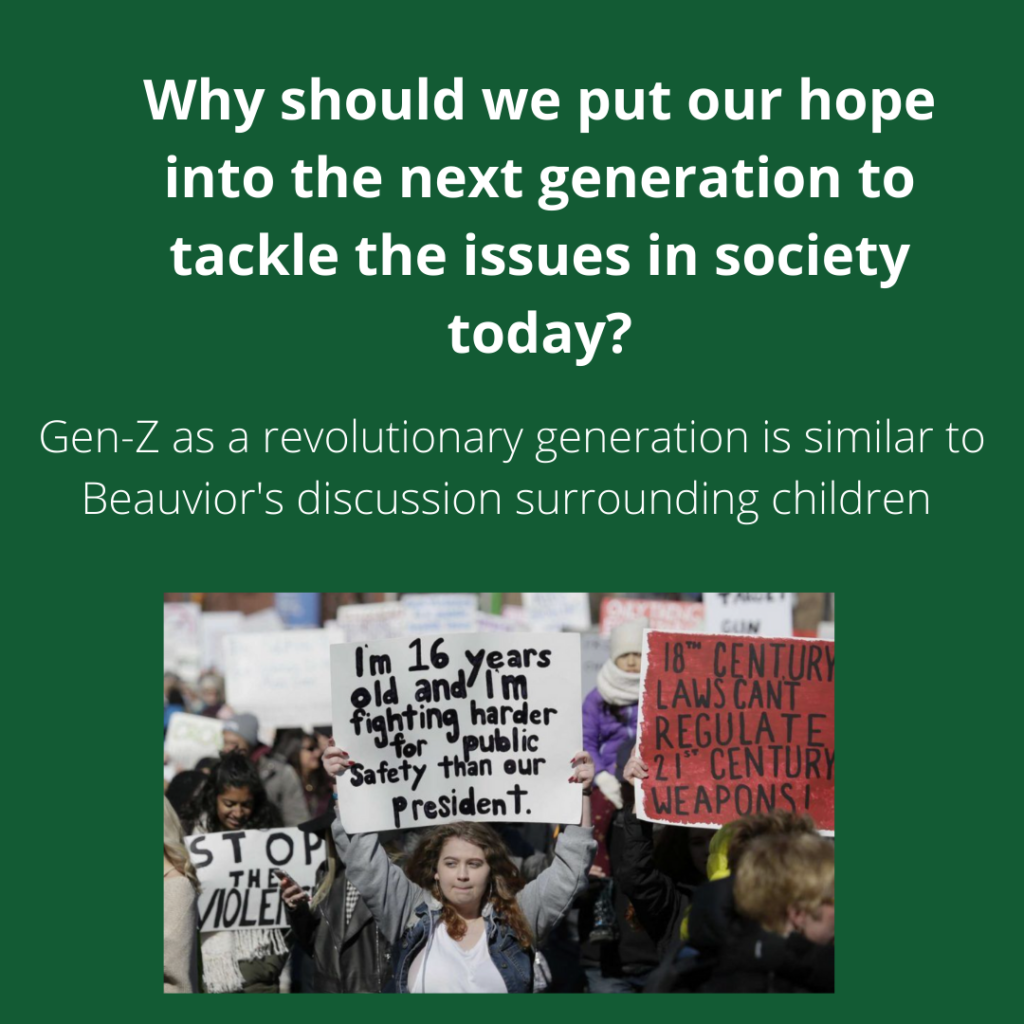
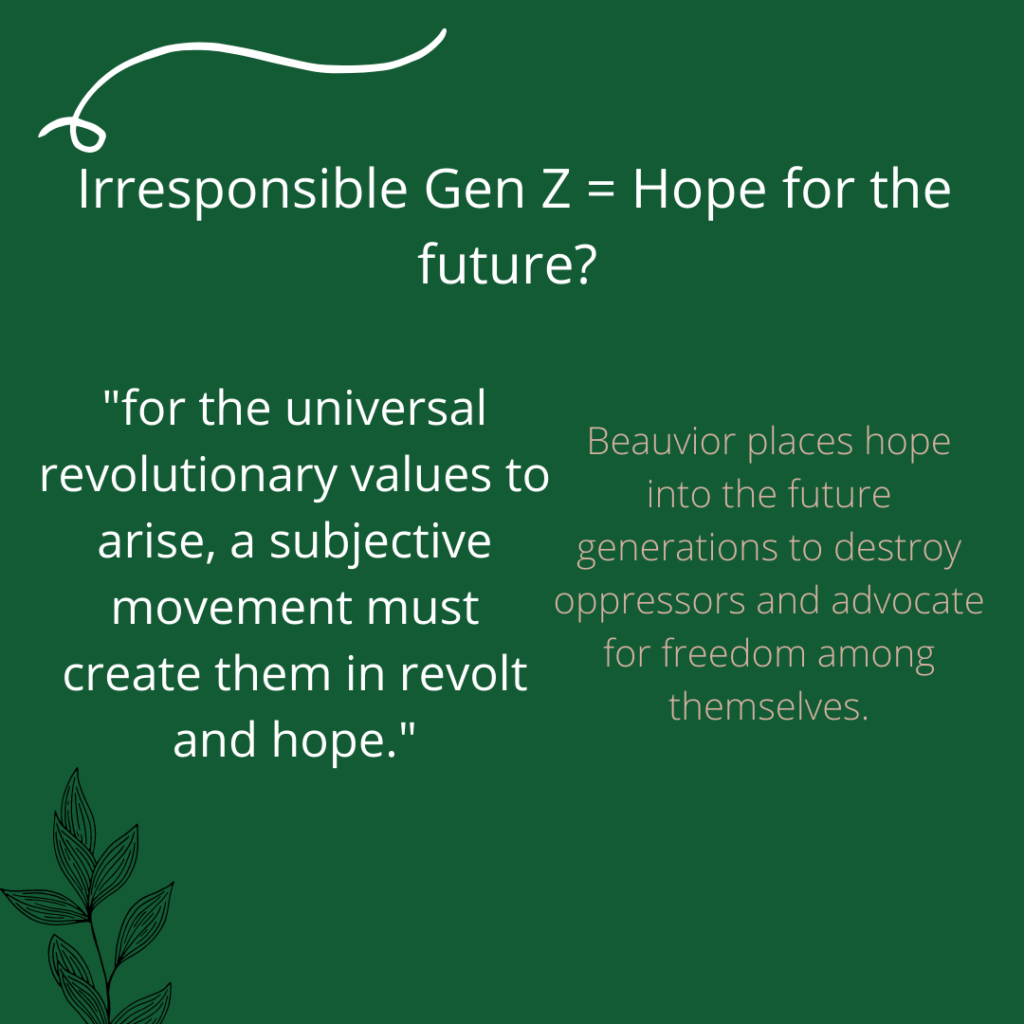
We have a duty to destroy those who outrageously deny certain communities their personal freedom, as well as the system that allows for them to carry on their regime. Beauvior also points out the extreme complexity of the world, and that “one can not fight everywhere at the same time and for everyone (50)”. Not everyone in the world can fight against those who oppress. In marginalized communities that are oppressed, a “child’s face is so moving (50)” since he is “a hope, a project (50)” While adults are obliged to destroy those who deny freedom, Beauvior describes children as a form of hope for a new and better future for oppressed communities. Children are the “living affirmation of human transcendence (50)”, they are the future of the world and are the project that will hopefully decide to maintain. freedom for others as an adult.
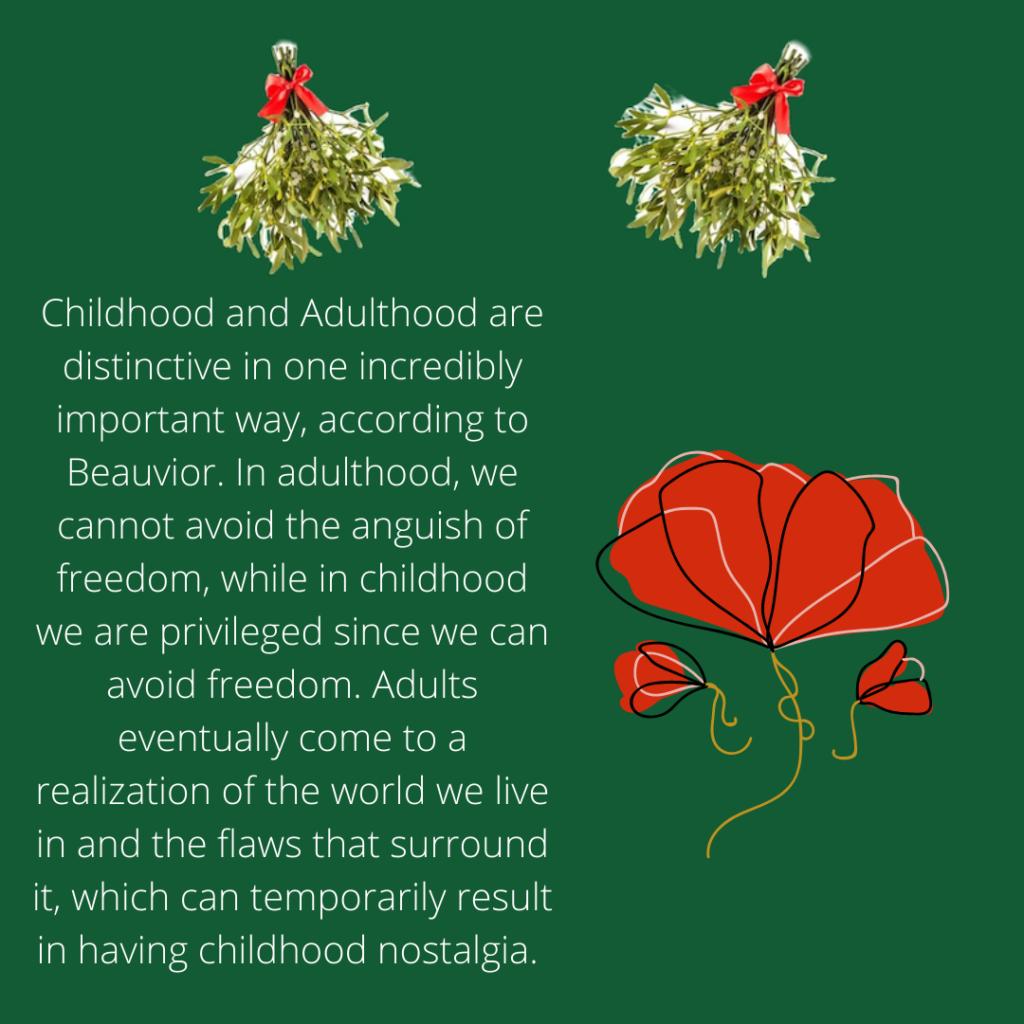
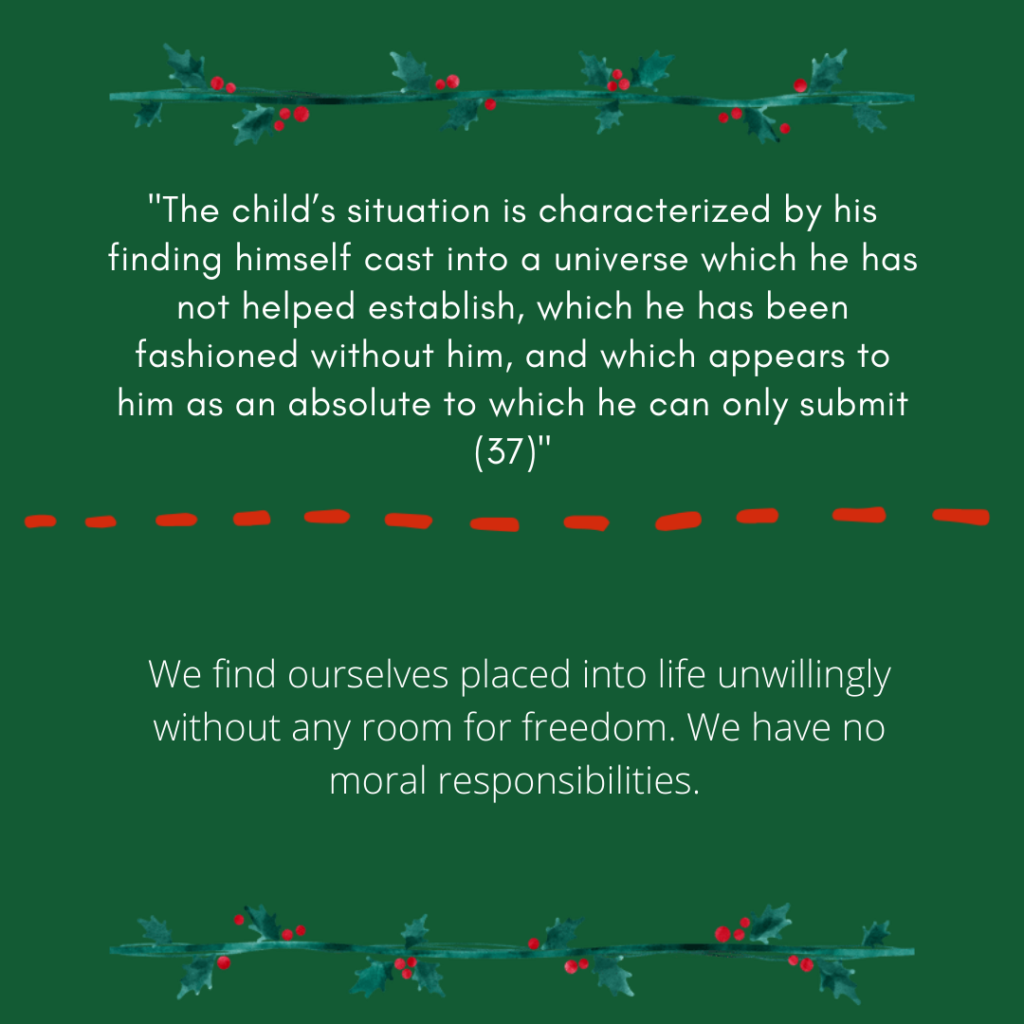
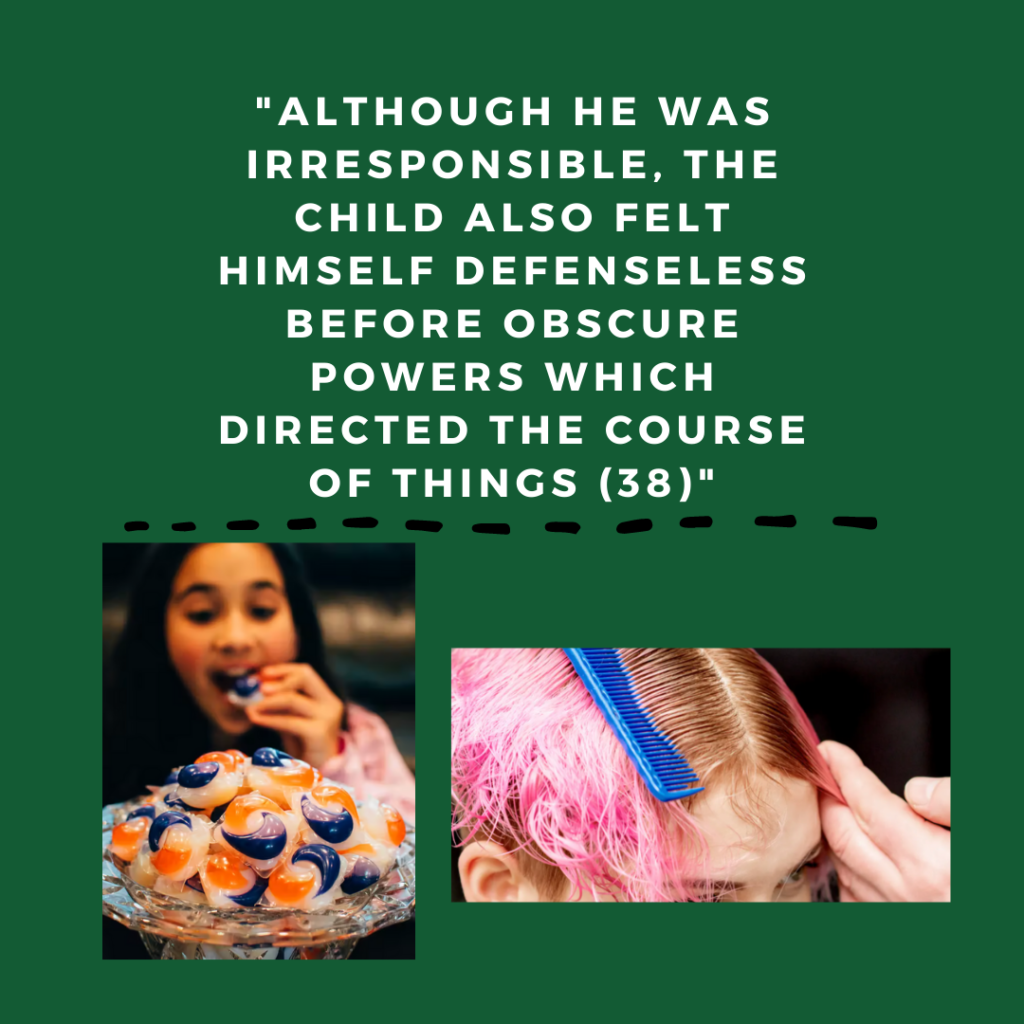
Children are involuntarily placed in a world that they have been cast in “which he has not helped to establish, which have been fashioned without him (37)” All the values and norms have been given to the child since they do not create the world they are born into. As an adult we become aware of the “serious world (38)” that we live in. As we start to grow up, we begin seeing these “flaws begin to be revealed in it (38)” in the world. These issues begin to reveal itself as we go through our adolescence. Beauvoir characterizes this transition as the “collapse of the serious world (37).” Even though we’re very naive and “irresponsible” in the stages where we can avoid freedom, there is a point where we transition to a point where we are the “prey of a freedom (37)”
Beauvior places so much weight surrounding the importance of being politically involved in order to reduce the oppression marginalized groups face in this “serious” world. The next generation of children give a sense of hope for the future as long as they choose to embrace genuine freedom for themselves and for others.
Story Instagram Post:
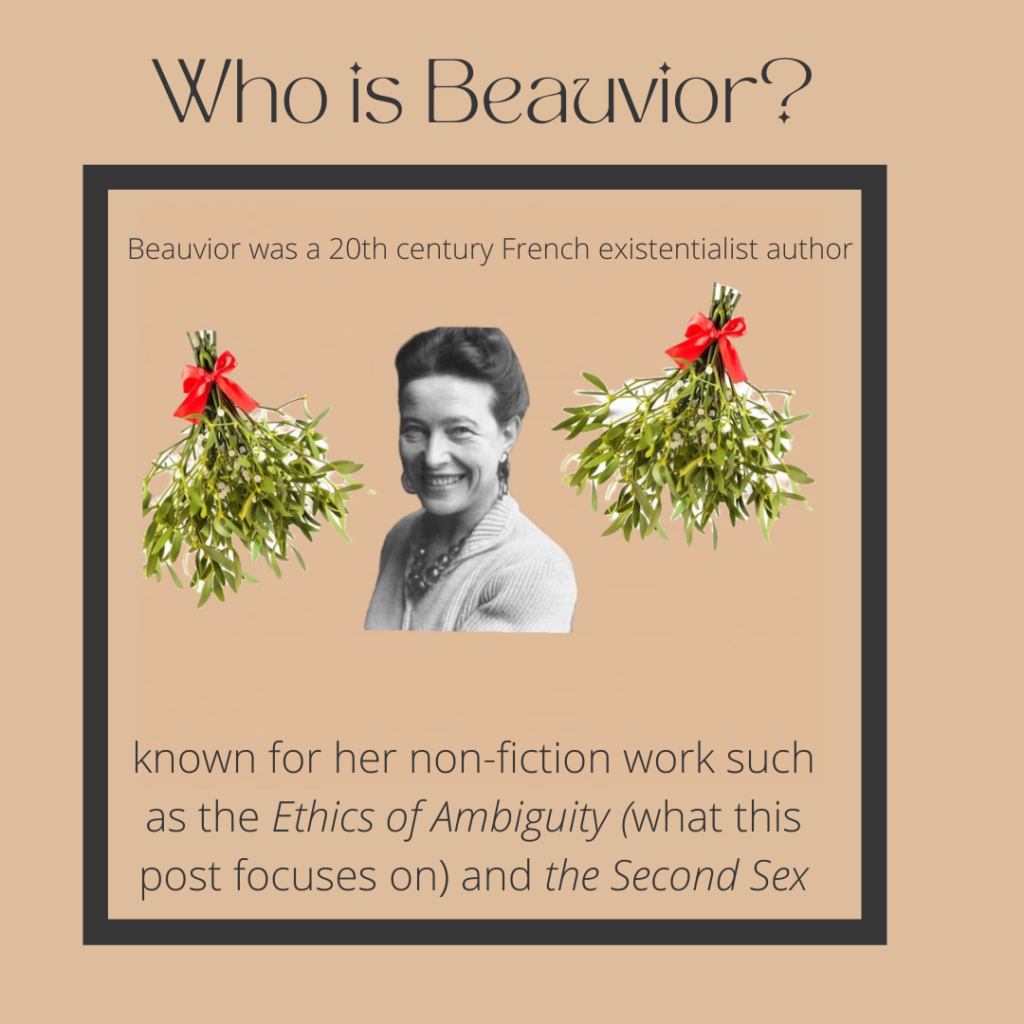
Instagram Grid Post

Grid Instagram Post #2
Tik Tok
Not sure if this video works on desktop but let me know if you want me to send it another way if it doesn’t load for you, the download link works (the three dots next to the volume button)
Reflection:
The most challenging part of this project was definitely the Tik Tok portion. I had to add speaker captions that sometimes did not align with my voice and I had to go back numerous times to edit so that the captions aligned with my voice. I had a lot of fun using Canva for my instagram campaign which was a super easy accessible LIFESAVER to use!! I used some minor photoshop on the instagram campaign and then transferred it over to Canva. Doing the blog first was a good option since it provided me a base to do my Tik-tok and instagram in a more casual way, so my blog has a deeper straightforward analysis while my Tik tok and instagram took a more artistic approach. Overall I spent a full day on just the blog portion to gather my thoughts and around 4 hours on the Tik tok script / editing/ photoshop and around 3-4 hours on the instagram campaign. Thank you guys for an awesome semester and I hope to run into everyone next semester!
